
I've moaned about these directory services before, but I notice they're all on a PR push, sponsoring TV programmes about dodgy traders and broadcasting annoying jingles on local radio. When it comes to these 'reputable tradespeople' websites, it's more a case of consumer beware..
There is one thing to bear in mind about these websites which claim to champion the consumer's cause: they are all for-profit businesses out to line their own pockets. None of them provide actual guarantees or assurances, and none of them effectively protect the consumer if a job goes awry. The most they can do is publish bad feedback and kick a trader off their database, although doing so robs them of an income stream so you have to wonder if such action is in their own commercial interest.
These services are little more than the traditional Yellow Pages but with customer feedback. As positive customer feedback is easy to fake, and as these businesses don't effectively send people out in the field to monitor and assess what's happening, you use them at your own risk. To that end I see them as part of the problem for the consumer rather than as a convenient solution; using one of these sites may give you false hope that you're going to get a square deal, but if things go wrong you'll quickly find you have no backup or comeback other than the opportunity of leaving a bad review.
Unfortunately, penning a bad review doesn't provide insurance, warranty support, get a bad job made good or recover any cash already handed over for duff work. Should you find yourself in that position, you still have your statutory rights to fall back on via Trading Standards, the small claims court and suchlike, but you'll be on your own to pursue a satisfactory outcome through such channels and will receive no support or compensation from these sites.
When getting a tradesperson in, especially for major work, check the following for yourself...
Most trades will be a member of a trade body that they are accountable to, whose code of practice they have to follow, and whose complaints and arbitration procedures they must comply with. A sparkymay be affiliated with the likes of NICEIC or NAPIT and/or a reputable trader directory such as Which? Trusted Traders. It's important to check any logo being flashed around by your potential contractor is checked for authenticity. Some good advice can be found on the INAEC website.
Don't be afraid to ask a tradesperson to see their insurances or qualifications. Valid and current membership of a proper trade association should indicate that they have already been vetted to ensure all checks and balances are in place.
Ask to be put in touch with referees. I'm happy to put my prospective clients in touch with previous customers for a reference or to take them to installations I have performed so they can see the quality of my previous work.
Ensure they have a valid trading address. Again, trade association membership should confirm this. Most tradespeople are self employed and like to get work on their own doorstep. As the crude saying goes, you don't shit where you eat, so hiring locally should mean the best service, but it's still important to check for legitimacy.
Get everything in writing beforehand. I always supply a written 'scope of works' for the larger jobs which details exactly what is involved, what is excluded and what unknowns there are, if any. Later variations to the scope can always be made but may affect pricing depending on how requested changes impact on time and materials, but you'll always know exactly where you are when it comes to my work and pricing. Don't leave anything to verbal agreement or assumption.
Anyway, let's take a closer look at some of these directory services to find out what they really offer...

The consumer posts a job "for free" on Rated People, tradespeople submit quotes in response, the consumer then chooses the tradesperson they believe is right for the job based on their pricing and feedback.
What the client doesn't see is, besides the cost of monthly membership, the tradesperson pays Rated People to submit each quote. The cost of this, obviously, has to be factored in to the cost of the job, so ultimately the client doesn't post their job for free if they appoint someone through Rated People. It ends up on their bill along with the overheads for other jobs the tradesperson paid to quote for but didn't win.
As well as that, the tradespeople know that they're in direct competition with others and they don't have the benefit of any word-of-mouth reference directly with the client, so it ends up as a race-to-the-bottom to provide the cheapest quote while still covering the Rated People overheads. The cheapest quote is often not the best one to go for, but the whole Rated People process seems to promote this way of working. The client, instead of getting the best person for the job, risks having a job where corners have been cut to accommodate costs.
As for protection, look at the small print on the Rated People website...
"[Rated People] makes no warranty regarding any goods or services purchased or obtained through listing a Project on the Website or via the Services or any transactions entered into through its Website."
"[Rated People] cannot accept any liability in respect of any contract or other agreement entered into between the Homeowner and the Trade Business. In particular, but without limitation, [Rated People] can accept no liability relating to the quality or fitness of any Project performed or omitted to be performed by any Trade Business (or any of its Sub-Contractors) and accordingly shall not be liable to the Homeowner for any dispute, act or omission resulting from any dealings between the Homeowner and the Trade Businesses and/or their Sub-Contractors including but not limited to any direct, indirect or consequential or inconsequential loss of any kind suffered by the Homeowner howsoever arising."
In other words, if you appoint a trade through Rated People and things cock-up, the most you can really do through them is leave bad feedback and ask for the trader to be removed from their site. Trying to get the job made good or money returned comes down to you. An example of a moody electrical firm found advertising on Rated People without accreditation was uncovered in Cowboy Competition #6.

You might recognise Checkatrade from their nasal-sounding jingle that bookends the commercial breaks of Channel 5's Cowboy Builders.
Check-a-trade doesn't deal with getting quotes, instead it's a code of practice that tradespeople agree to abide by. The issue I have with it is that it's just a common sense code of practice which any reputable tradesperson would abide by anyway in order to keep on the right side of Trading Standards and any legitimate trade association. Check-a-trade can only ask their members to comply and lack any power to be able to enforce compliance. If a tradesperson really wants to sign up to a meaningful code of practice, then they're better off joining the government licenced TrustMark scheme which actually holds them to account via their trade association and provides an arbitration service.
Again, a quick look at the Check-a-trade small print reveals their true colours...
"Our members remain independent businesses responsible for the work they each carry out. It is not possible for us to guarantee the quality of our members' work or approve them as a trading association would."
So, if you appoint a trade through Check-a-trade and things don't go according to plan, the most you can really do through them is leave bad feedback. Although they offer 'investigations and dispute resolution', ultimately they have no power to do anything more than kick a trader off their directory. Again, getting the job put right or any money recovered is down to you.
Just to prove the perils, here's a case in point. A handyman/bathroom fitter outfit in Maidenhead has been posing as NICEIC accredited for electrical work when they hold no such accreditation. NICEIC have got wind of this and have contacted the business telling them to cease and desist. If the company does so, then NICEIC back off, but if not, then they may take further action including listing the company on their Wall of Shame as is the case here...
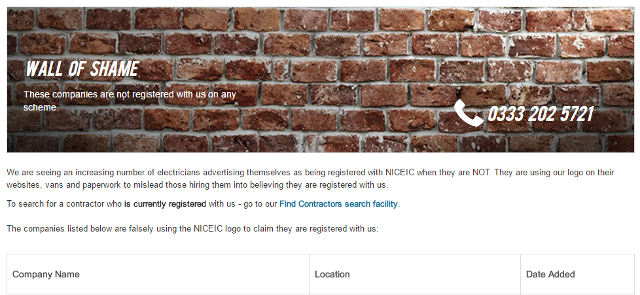

I've blurred the name although it'll be easy enough for anyone to find who I'm talking about, but seeing as this company appears on the Wall of Shame, then it suggests they ignored the cease and desist and may still be falsely using the NICEIC logo. So, let's have a look at their Check-a-Trade page shall we?


Wow. I'm seeing the words Interviewed, Vetted, Monitored, Checked, along with background checks, references, reviews... and yet this is a company falsely claiming to be NICEIC accredited for electrical work according to NICEIC themselves. In fact, NICEIC have gone so far as to publicly distance themselves from this company.
Seeing as electrical work in a bathroom is classed as a 'special location' by BS7671 and comes under the rules of Part-P making it notifiable under the Building Regulations, it leaves you wondering how qualified and insured this company is to be modifying electrics in bathrooms and how they're certifying their work, if at all. It may be that it's all above board and they use a third party contractor to legitimately oversee and sign off the work, but they've obviously been caught with their pants down flashing the NICEIC logo, yet I don't see Check-a-Trade doing anything about it. How many other businesses have been vetted and checked by Check-a-Trade without them picking up on something so simple as a cross-check of valid accreditation?

Moving on, Trustatrader is similar to Rated People from what I can tell. The tradesperson pays to be a member of Trust-a-trader and has to pass that cost on to the client. The client gets the usual impression that they are in some way protected, but the small print says otherwise..
"(a) Although we make an effort to ensure tradesmen, suppliers and companies listed on the Website are legitimate, reputable and have appropriate qualifications, membership to and/or approval of trade related bodies organisations and associations and that the information on this Website is accurate, the listings are compiled from information supplied to us from the traders, suppliers and companies listed and we cannot be held responsible for any errors or inaccuracies in such information or for the suitability or quality of any services or goods supplied by such third parties listed on or linking to the Website.
(b) The appearance of a listing in the Website does not necessarily imply our approval of the tradesmen, suppliers or companies.
(c) We accept no liability for any transactions which take place between you and any parties listed on the Website."
All the above companies, and any similar ones not mentioned here, do provide a valid service, but only to the same sort of extent that the Yellow Pages or Thompson Local provides. They put clients together with tradespeople, except they offer the chance for feedback to be left. There's no suggestion here that they are disreputable, and I'm sure they have plenty of both happy homeowners and satisfied tradespeople who have used them successfully. In my opinion however, they offer a false sense of assurance because their only power if things go bad is to kick a trader off their individual database. The only real way you can be sure of having insurance backed protection when getting a trader in for major work is to check for yourself that they have current trade association membership and insurance rather than relying on a third party directory which may not hold accurate feedback or up-to-date information. If you choose to use these services, bear in mind the risks and limitations.
All that said, there are a couple of non-accreditation exceptions to the above that may be worthy of consideration when hiring a trade...
 |
 |
Which? do vet the members of their Trusted Trader scheme to ensure they meet the operational standards required. Site visits and checks on processes and procedures should mean that a Which? Trusted Trader is a safer bet, and Which? offer an Alternative Dispute Resolution (ADR) service through an official ombudsman to act as a go-between should the relationship with the client and their member go particularly sour. I joined the Which? scheme in 2017.
The Government TrustMark scheme is a not-for-profit service that also provides customers with additional security and an ADR service should a job go bad with a tradesperson registered as one of its members. I was a member of TrustMark from 2013 to 2016, but I gave them up because of an incident I came across and documented where a cowboy installer was allowed to become a member. Opening the door to just anyone who pays up simply devalues the brand, and where I once recognised it as a stamp of additional security, I'm no longer convinced they do enough to protect the value of their reputation. That said, I rejoined TrustMark later in 2017 simply because my membership of the Electrical Contractor's Association allows me to be on their database at no additional cost, however I no longer fly the TrustMark flag as prominently as I once did, having lost my faith in them as I have.
Submitting a work request through one of the above directory sites may mean you end up with any old Tom, Dick or indeed Harry, and you may get stuck with a bad job, no paperwork and a legal headache with your only redress being to pen a negative review.

AFF6